
‘Knytt Classic’ Celebrates 20 Years of Knytt
The indie freeware classic returns! It’s been 20 years since visionary Swedish indie developer Nifflas (Rhythm Doggo, Ynglet) released Knytt, the first title in the atmospheric platforming series. Made with the help of a passionate group of internet forum collaborators, the game was released for free on the web in 2006, and later followed up by Knytt Stories (2007) and Knytt Underground (2012). IGN called Knytt “an extremely soothing and memorable ambient adventure”, while Edge Magazine remarked it was “pure platforming pleasure and a wonderfully soothing soundscape.”
To celebrate the 20th anniversary, Bit Kid (Chasm, WOLFHOUND) is proud to present Knytt Classic, a cross-platform port with full controller support, achievements, bonus modes, display effects, and much more!
Grab it now 100% FREE on Steam and GOG!
Features
- A pixel-perfect port of Nifflas’ indie freeware classic Knytt (2006)
- Over 1,500 screens to explore across the original game and three bonus modes
- Bonus Modes include UltraTough, a brand new challenging mode by Bit Kid, Hempuli’s (Baba Is You, Environment Station Alpha) mod Knytt XH (Extra Hard), and Brutally Unfair Knytt’s remixed world
- Achievements & hidden bonuses
- Full gamepad support and remappable controls
- Multiple aspect ratios & display effects, including retro CRT and handheld LCD styles
- Optional in-game timer and fastest completion time tracking
- Windows, Mac, Linux & Steam Deck support
Flashback
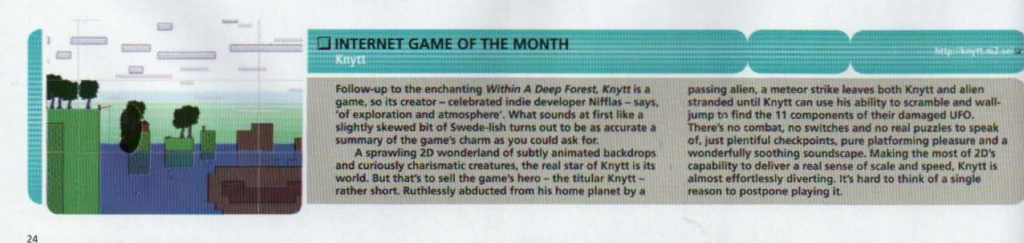
The world was a much different place back in 2006 when Knytt came out. The indie game revolution as we know it hadn’t happened yet. You were just as likely to get gaming news from print magazines as the internet. Information on game development was also much more limited. You had to go buy a book or two, and hope they were relevant to the technology you had at your disposal.
That same year, I was flipping through a magazine and saw an advertisement proclaiming “Make Your Own Games!” The next thing I knew, I had a copy of Torque Game Builder and an itch to make games. But like most everyone else who begins, I didn’t really understand how games were made so I spent a lot of time writing elaborate game design documents full of impossible ideas. It was during that phase of coming up with the next big idea and then quickly abandoning it after realizing how infeasible it was that Knytt came out.
It was a lightbulb moment for me – the perfect example of what a small team with no budget, working remotely on the internet could achieve. It had great controls & platforming, a unique atmosphere with a big world to explore, and of course secrets galore. But it also it showed me that “more” wasn’t necessarily better. The art of game design was just as much in what you don’t include as what you do. That philosophy of minimalism has always stuck with me since.
Mission Start
Jumping forward nearly two decades to 2024, I was excited to check the game out again, but quickly became annoyed. I was nostalgic and in love with it all over again, but also very, very annoyed! Knytt was created with a game creation program called Multimedia Fusion 2, and while it’s a neat program that helped some great games get made, they unfortunately haven’t aged so well.
Right out of the gate I noticed the Fullscreen option was broken and at best left you with a blurry, stretched mess. Then I realized controllers wouldn’t work without setting up a separate keymapper application. Lastly, there was the choppiness. The game is designed for 50hz displays, which is a little odd for 60hz desktops and digital TVs, but there also seems to be performance issues with the old GDI drawing method it uses in modern Windows.
And so the idea naturally hit me: how hard would it be to recreate the game inside Bit Kid’s FNA / SDL3-based game engine? Most of the functionality it would need to play cross-platform on modern systems was already there. The time consuming part would be recreating the world faithfully. It didn’t take long to extract all the graphical assets, music, & sounds from the game, but then the tedious part started: build a tileset out of them and go screen by screen and duplicating it as precisely as possible.
Once the game was playable I knew I had to port Hempuli’s excellent Knytt XH mod, the Brutally Unfair mod, and of course did my own little hard mode as well. Throw in some stats, achievements, and new bonuses and now its an edition worthy of celebration! A huge thanks goes out to Nifflas for giving me this opportunity. It was a seriously fun project to take on and I’m thrilled to have the game available again for new players to experience.
Nifflas Interview – August 2026
- Q: How long were you making games before starting work on Knytt?
- A: Knytt was one of the first games I had made, I had made three small games before and only one of them (Within a Deep Forest) had gained a bit of popularity. It’s a game I primarily wanted to design as a “place” rather than a story or challenge. So, making it was mainly having a very simple set of movements, then spending a lot of time just creating the world.
- Q: Knytt is one of the first titles I remember hearing about that was collaborated on over the internet. What led to that?
- A: I knew musicians from an IRC channel called #modarchive and it came quite naturally that I’d ask them to help me with music.
- Q: How did you approach designing out the world? Did you start with the crash scene and work outwards from there?
- A: I designed Knytt’s world from left to right-ish. It was mostly done by feel without any plan, and if I remember right, this was quite intentional. The world feeling like a place rather than existing as a challenge to the player felt important to me.
- Q: How did you arrive at wall climbing as the primary traversal mechanic?
- A: I don’t remember why I included the wall climbing the way I did, but I imagine it being it was easy to level design a world around without needing lots of small platforms for the player to traverse upwards. It definitely allows for a world that doesn’t look too “player traverse shaped.”
- Q: The minimalist design of the game stands out even more now than it did then. Were other abilities, hazards or collectibles ever considered or cut?
- A: If I remember right, knew nearly from the start I didn’t want the character in Knytt to have extra abilities. It was not the focus on the game, and the minimalism of the game’s design was very intentional. So, I don’t think I cut anything.
- Q: The denizens of the world are all very unique. Did you have them planned out or did others come up with them?
- A: Both me and others designed the little characters who appear in the world. I had a rule that every character must only appear once, tho similar characters can appear if there are some pixels of difference. We came up with them on the fly. The main reason they’re there is to make the world feel lived in, and for it to be rewarding when exploring the game. I hope I get daring enough to return to that kind of design, where just seeing something can be a reward, without it needing an interaction or affecting progression.
- Q: How do you see Knytt fitting into your career now? Your latest title Rhythm Doggo seems to share some of its DNA.
- A: This is an interesting one! Knytt and Rhythm Doggo definitely share a focus on atmosphere and place, and these aspects reflect how I view life back then and now. Knytt’s world is a very serene, bright and summery world and is mostly safe but with small parts of danger. Rhythm Doggo is the inverse of this, a dark world set either at night or in heavy rainfall, where you find pockets of safety in shelters, where dogs and other creatures hang out. These aspects of the games reflect how I view life, and I hope to in the future become a person who has it into me to create a much happier game like Knytt again.
- Q: Is there anything the world doesn’t know about Knytt (or its development) that you think they should?
- A: Originally, Knytt was a little side experiment I made when I was developing WIthin a Deep Forest 2. I’m not even sure I intended to finish the game first. The first WaDF had been fairly popular and I wanted to make a sequel, but I never “connected” to it the same way I connected to Knytt instantly when starting making it. I very rarely abandon games but it was definitely the right choice here.


